
Safe Rooms
Safe Rooms / Panic Room and Refuge Areas
The interest in the provision of Safe rooms (also widely referred to as Panic Rooms, Saferooms, Safe havens or Safehavens depending upon which country the search originates) has increased dramatically over the last few years. Brought more into the public’s attention by the film ‘Panic Room’, they are not only used in residential homes but also in commercial buildings and other specialist applications.
Commercial shipping has recently begun to install a panic room, or in many cases several panic rooms on board its oil tankers and commercial cargo ships. In applications such as these, panic rooms do not necessarily require the aesthetic appearance of that which is expected within an Embassy or residential home. We supply pre formed steel armoured panels and pre fabricated structures which blend into the general appearance of commercial vessels.
Attacks by pirates, who are regularly armed with AK47 rifles (7.62 bullets and ammunition), automatic weapons, rocket propelled grenades (RPG) hand grenades and indeed most commercially available weapons are becoming increasingly common. Panic rooms and safe areas on board ships are also fitted with ballistic doors and in addition to cameras; they are fitted with several ballistic peepholes, also referred to as door viewers or spy holes. This provides all round peripheral vision outside of the panic room.
Residential panic rooms within Embassies, apartments, villas and palaces are becoming more common place. Not only as a safe area for people should an intruder enter the property but also for the storage of valuable items such as paintings and antiques when the property is left unoccupied for any length of time.
Blast and Ballistics Ltd. also provide modular panic room systems with security, ballistic and also blast ratings for cost effective and easy installation within existing areas without the need for extensive building work and reconstruction. See our guide to panic rooms below.
A Saferoom or 'Safehaven' as it is sometimes referred to can be a purpose built room or an existing room which has been upgraded to provide a safe refuge in both residential and also commercial environments.
Main features
- Ballistic ratings up to FB7 - 7.62 Armour piercing ammunition, tested and certificated
- Sectional wall construction for ease of assembly
- Available in all finishes to compliment the immediate surroundings
- Particularly suitable for hotel lobbies and private residence.
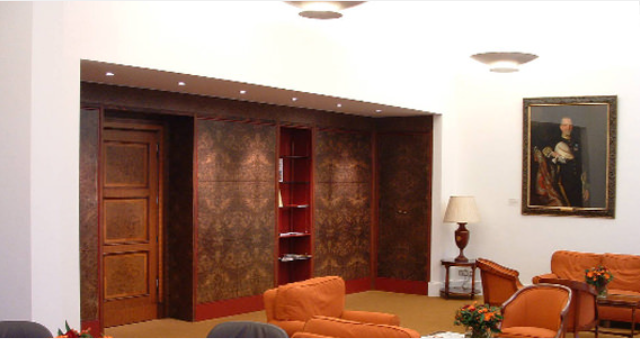
Entrances to safe areas should be discreet and in keeping with the surrounding environment, yet still provide physical and ballistic protection.
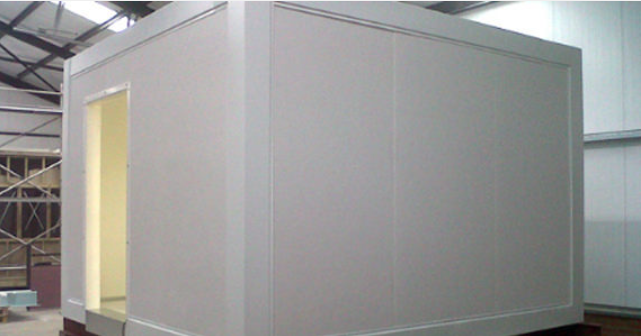
Pre-Fabricated panic rooms ca be quickly and easily erected on site saving time and money. They can be stand-alone units or integrated into an existing room.
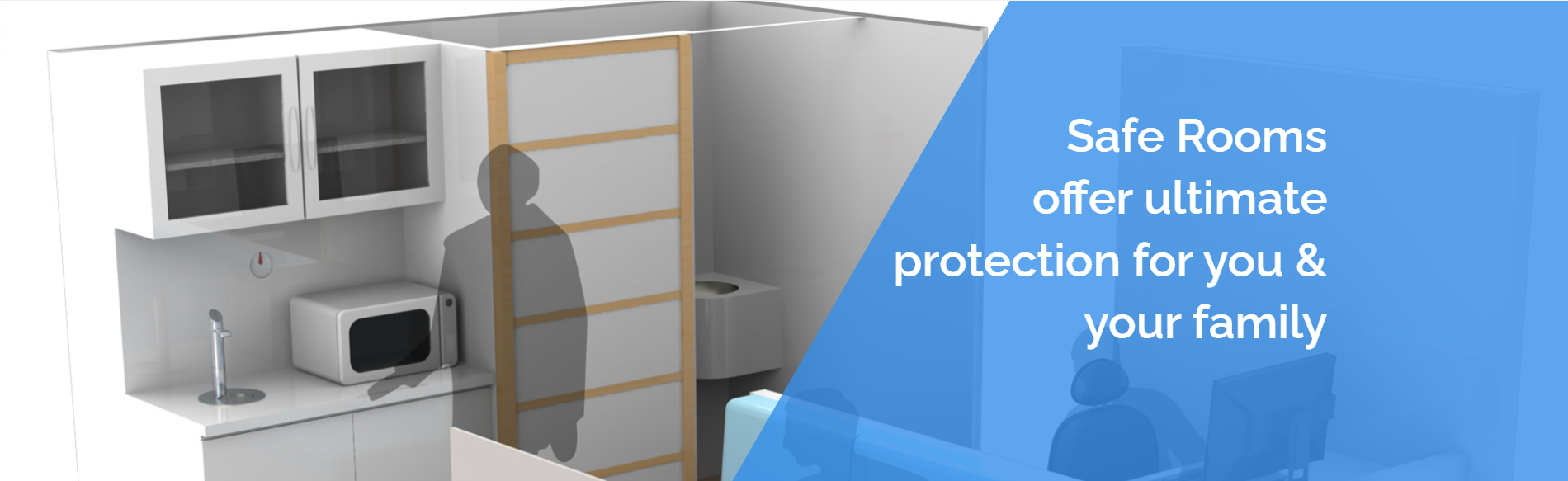
Saferoom Design – Outline Specification
The primary purpose of both domestic and commercial Saferooms' is to offer immediate and easily accessible refuge in situations whereby a person's life or well being may be compromised.
In doing this there are many things that need careful consideration. This is a preliminary outline of the key factors that need consideration when constructing or installing a Saferoom into an existing property.
Levels of Protection
- What is the anticipated length of time considered likely for occupants to be taking refuge within the Saferoom ? Is a Police response likely within minutes or is the location fairly remote and Police attendance may therefore be protracted
- What is the real value of a potential target and might the threat be from burglars intent upon taking property, or from persons who are armed and life itself may be at risk
- How well prepared may an assailant(s) or intruder(s) be ? Might they be armed with simple tools, professional tools, weapons or all three perhaps
- Might they be speculative intruders or trained and highly focused individuals
- Unless the threat can be accurately determined there will always be a threat versus cost comparison in determining a final design solution
- What are considered to be the minimum requirements for protection against a determined intruder and subsequently what type of materials will be required
- Physical attack upon the Saferoom using hammers, crow bars and other blunt instruments
- Weapons – generally shotguns and hand guns up to .44 Magnum and 9mm fully automatic weapons in higher levels of threat
- Rifles - possibly in more remote areas as their concealment in and around densely populated areas is far more onerous
Location of a Saferoom
- It or they must be easily accessible at all times. It is unlikely that in the event of an intrusion that the occupant will have time to give consideration to anything other than seeking refuge as quickly as possible for themselves and other family members
- They may need to seek refuge at any time of the day or night. Events rarely occur at a convenient time and collecting ones thoughts and determining their actions when suddenly awoken from a deep sleep perhaps is challenging.
- The route to each Saferoom should therefore be borne in mind at all times and rehearsed with other members of the family.
- The route to the Saferoom must be unhindered and the access route lit to some extent to assist family members gain access quickly.
- In large properties it will be necessary to give consideration to several Saferooms or areas. An intruder may have penetrated a building and when the family members are aware of their situation may realise that access to certain areas of the building are no longer safe and an alternative refuge must be considered.
- Access and speed is vitally important hence the requirement for more than one Saferoom within some properties. Leaving a family member in the company of an intruder may invalidate and compromise those already inside a Saferoom
- Protecting the entrance to a Saferoom is equally important. Having a door that looks like a strong room or vault door will serve only to identify a potential area to target. The time taken for an intruder to initially identify where the family members are seeking refuge takes valuable time. Time is one of the most important things to an assailant.
Constructing the Safe Room
Having chosen suitable refuge areas it is then time to give consideration to actually constructing the room itself. This is where a specialist design is required. The clever use of some or all of the existing materials in a Saferoom will be cost effective and cause minimum disruption.
Retrofitting of Saferooms always causes more disruption and is less cost effective yet the provision of one remains just as critical. Here are examples of what can be expected from existing materials and how the introduction of new materials will benefit its construction:
- Existing concrete walls, floors and ceilings are ideal. Usually found in plant rooms and service areas they provided good protection against both physical and also ballistic attack.
- Next to that are conventional brick walls. It is important to remember when assessing such materials however that a brick wall offers reasonable ballistic protection but can be broken through without too much difficulty with a sledge hammer. Lightweight blocks offer similar levels of protection.
- Stud walls offer little protection from any sort of attack and at best the only protection that they may offer is to provide cover whilst an assailant looks around the property.
- Wooden floors offer reasonable protection from assailants in the room below because of the difficult nature in accessing the ceiling with tools when working overhead. They offer no ballistic protection and in consequence if the Saferoom above has unprotected flooring and the assailant has identified this he will easily be able to intimidate the occupants to leave the Saferoom.
- Few existing doors will ever offer protection for Saferooms to the required levels. A shotgun will cleanly penetrate any timber door leaf and to stop the penetration of a .44 handgun for example the door leaf would need to be constructed in sold plywood and over 125mm thick. This is clearly not practical and therefore the provision of a specialist door and frame which is a matching set must be sought. This can also be made to look similar to other existing doors within the property which again adds to confuse an intruder and also provide more time for the occupants to seek refuge. If all of the doors look the same then theoretically an intruder will have to give each one of them equal consideration.
- Introducing ballistic materials is usually inevitable in most properties. These need to be considered for protection to walls, floors and ceilings. They should also be integrated to the specialist door set. Weight and cost are also considerations that have to be borne in mind. So too existing decoration.
- Consideration should also be given for allowing the occupants of the Saferoom to see who is outside of and also adjacent to the door. Otherwise how will they be able to identify when rescue arrives ? It could be misinterpreted for the assailants and they may refuse to open the door. This provision is accomplished by means of a small CCTV camera outside of the door with a video monitor within the room itself. However, electronics can be tampered with and in the event of an emergency if the camera were to be covered over then the occupants would be unaware as to whether this was the case or if there was a simple equipment failure. A wide angle ballistic door viewer fitted into the door, or adjacent wall if suitable, would provide a more robust means of carrying out this exercise. If it were the case that at some point it was not possible to see through the viewer then without doubt the occupants can be certain that it had been tampered with by persons outside of the room.
Equipment within the Safe Room
- Few if any amenities may be needed within a Saferoom if Police response is imminent. Communication to the outside world however is critical. So is internal communications to other Saferooms to enable the occupants to collate information as to the whereabouts of other family members. This will offer reassurance and also provide clear guidance for Police when entering the building.
- Internal communications are important but consideration should also be given to assailants accessing this system and in consequence using the internal system for intimidation purposes. Although the telephonic hardware is an important inclusion within the Saferoom its operation would need careful planning.
- Drinking water is important. Small bottles of water are easily stored and offer immediate refreshment helping greatly in times of stress.
- Toilet facilities may need to be considered in some instances. Although fixed sanitary ware is ideal it may not be practical in some instances. Portable toilets easily provide welfare in an emergency.
- Auxiliary lighting or hand torches which are on constant charge, flashlights with spare batteries or even 'wind up' torches are another basic requirement within the Saferoom
- Spare clothes or blankets are useful should the Saferoom need to be used during times when there is no heating in place. Having to use the Saferoom is in itself a difficult and stressful event and so the inclusion of warm fabrics will all help to provide pockets of comfort.
- Sufficient air within the room is also a major consideration. Several factors need to be considered with respect to this matter. How many people ? What is the volume of air within the room ? How long may people be expected to remain in the room ? Is there a secure flow of air already entering the room ? Should an auxiliary source of filtered air be considered
- First Aid Kit.
- Fire Extinguisher.
What Materials are Available
By far the most cost effective materials are general low grade steels which have been ballistically tested. Designs with this material to provide protection levels to European Standards FB4 (handguns and shotguns as detailed previously) normally add around 50kg kg/m² to each room. Should this be needed on floors and ceilings in addition then the weight within the building will increase significantly and structural analysis may need to be sought
Armoured steels will reduce the loadings by 50% immediately but will also double the cost. This will weigh around 24 kg/m². A similar loading can also be expected with the use of composite armour albeit that is again around 50% more expensive than armoured steel. All of these materials need to be cut using laser or water jet machines and pre planning and design are therefore crucial to the success of the installation.
Soft armour is the most versatile material of all in these situations. A Kevlar based product, it can be inserted into cavities, formed around difficult shapes and so forth but its great advantage is its weight. Typically weighing around 7 kg/m² it creates fewer problems and can be installed with general tradesmen albeit under specialist supervision making installation far less intrusive particularly in domestic residences. The cost however is over twice that of armoured steels. This is attractive in terms of ballistic protection but consideration must also be given along with this material in terms of physical attack. Other materials may also be required in addition to this if the existing structure is deemed deficient in this aspect.
Frequently Asked Questions
Do you offer a site survey / in-person visit?
Yes, to best understand your situation and potential threats, we arrange an in-person survey to visit the site to best assess what levels of protection are required.
Is this a bespoke solution?
Yes, we do not believe in 'off-the-shelf' products, every solution is bespoke.
Do you offer installation?
Yes, we offer a full installation service.